Skip to main content Skip to footer

Neglect

Neglect is defined as  “The persistent failure to meet a child’s basic physical and/or psychological needs, likely to result in the serious impairment of the child’s health or development. Neglect may involve a parent or carer failing to:

• provide adequate food, clothing, and shelter (including exclusion from home or abandonment)

• protect a child from physical and emotional harm or danger

• ensure adequate supervision (including the use of inadequate caregivers)

• ensure access to appropriate medical care or treatment

• provide suitable education

It may also include neglect of, or unresponsiveness to, a child’s basic emotional needs”

This can be found in the document  Working together to safeguard children 2023: statutory guidance

Neglect type

Features associated with type of neglect

Educational neglect

Parent/carer fails to provide a stimulating environment or show an interest in the child’s education at school/education provision. They may fail to respond to any special needs and fail to comply with state requirements about school attendance

Emotional neglect

Parent/carer is unresponsive to a child’s basic emotional needs. They may fail to interact or provide affection, undermining a child’s self-esteem and sense of identity. (Most experts distinguish between emotional neglect and emotional abuse by intention; emotional abuse is intentionally inflicted, emotional neglect is an omission of care.)

Medical neglect

Parent/carer minimise or deny a child’s illness or health needs and/or fails to seek appropriate medical attention or administer medication and treatment.

Nutritional neglect

Where a child does not receive adequate calories or nutritional intake for normal growth (also sometimes called ‘failure to thrive’). At its most extreme, nutritional neglect can take the form of malnutrition or obesity.

Physical neglect

Parent/carer does not provide appropriate clothing, food, cleanliness and/or living conditions.

Supervisory neglect

Where a parent/carer fails to provide an adequate level of supervision and guidance to ensure a child’s safety and protection from harm. For example, a child may be left alone, abandoned, left with inappropriate carers, or they may not be provided with appropriate boundaries about behaviours (for example, under-age alcohol use) may not be applied

Children have the right to a positive childhood experience, including having their basic needs met.  In sessions with young people in 2024-2025 they told us that they;

  • want to be listened to and heard
  • for professionals to talk to them and take them seriously
  • to care and show it
  • to give them choices
  • to build trust, for example talking about themselves so that children can get to know the professional better

Young people spoken to during sessions carried out in 2024-2025 displayed a mature and thoughtful approach to recognising and supporting their peers whose needs may not be met. One example was given by Salford young people of a group of friends paying for another friend’s lunch as she never had packed lunch or lunch money. 

Children said they would go to a youth worker, other family member, sibling, teacher, or their best mate if they were worried. They said they would not post on social media, as ‘social media is for happy things’. 

Young people were keen to see a campaign at child level to improve this, to include posters, assemblies, inclusion in school mentoring programme.

They felt the following would help prevent neglect:

Pre-School

Primary

Secondary

Communication
•Social Interaction/having fun
•Parent support classes
•Toilet training
•Basic reading
•Consistency e.g. attending appointments
•Finance/budgeting advice for families


•Neurodiversity recognition and early help
•Education on YP’s rights
•Have the right to speak up and be listened to (Freedom of expression)
•Be aware of safe spaces and touch/ non-touch areas of the body
•Know when and how to seek help
•Right not to be bullied


•People to trust and listen to them
•Involvement in setting agreed boundaries
•Be able to feel safe walking down the street
•Protection from social media/cyber bullying/dark web/AI
•Education on safety
•Life lesson classes
•Free sanitary products and body wash
•Mental health care
•Encourage ‘difference’
•Access to services – let YP know about them and how they can engage
•Free equipment in school e.g. pens pencils.
•Suitable place in school to revise
•Encourage and promote aspirations for the future
•Education on YP’s rights


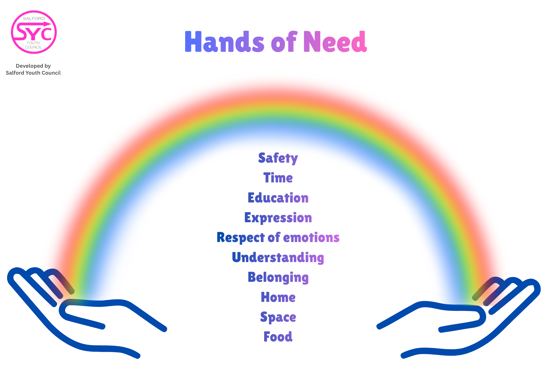
In 2025 Salford Youth Council reviewed the ‘Hands of Need’ and added the following areas of need:

  • Safe space/shelter
  • Health Care (personal hygiene, clean clothes)
  • Agreed boundaries
  • Mental health/well-being

Their main message to professionals was that:

"YOUNG PEOPLE NEED TO KNOW THEIR RIGHTS".

Latest news

Details of all the latest news from the Salford Safeguarding Children Partnership.

Cookie notice

Find out more about how this website uses cookies to enhance your browsing experience.